Schizotypal Personality Disorder in the DSM-5-TR
Schizotypal personality disorder only made its debut in 1980 in the DSM-III when it was separated from schizoid personality disorder. Schizotypal at the disorder involves odd thoughts, perception, speech, and behaviors that aren’t severe enough to be fully psychotic or meet the criteria for schizophrenia, so they fall in the personality disorder category. The most recent (2022) criteria of schizotypal personality disorder can be found in the DSM-5-TR (Diagnostic and Statistical Manual of Mental Disorders, Fifth Edition, Text Revision1). Currently, theorists still differ in their acceptance of schizotypal as a personality disorder separate from schizoid. As usual, it’s a mess, but let’s focus on how the DSM-5-TR portrays schizotypal personality disorder.

| Note: Text in these boxes are the exact words from DSM-5-TR1 |
|---|
Schizotypal Personality Disorder Criteria
| “A pervasive pattern of social and interpersonal deficits marked by acute discomfort with, and reduced capacity for, close relationships as well as by cognitive or perceptual distortions and eccentricities of behavior, beginning by early adulthood and present in a variety of contexts, as indicated by five (or more) of the following:1” (p. 745) |
|---|
The DSM-5-TR provides a frame for schizotypal personality disorder, noting the patterns must be pervasive, meaning it is observable in multiple parts of life. Schizotypal personality traits can show up early, but must begin by early adulthood across different settings (e.g. home, school, work). Like all personality disorders, it doesn’t just randomly show up in middle age…it’s part of your development and person. The primary patterns involved in schizotypal personality disorder include altered thought and perceptions that result in odd behavior and intense discomfort with social interactions. There also has to be five or more of the following noted in the boxes below.

| “Ideas of reference (excluding delusions of reference)1.” (p. 745) |
|---|
The first criterion involves ideas of reference, which is an egocentric thought process that involves believing neutral events have a causal, special, personal meaning. An example of an idea of reference is believing that everyone in a car that passed you on the highway is talking about you, but then 2 hours later when telling your friend about it, you come to think your belief probably isn’t likely. Note that this is NOT delusions of reference, meaning it’s not at a level of psychosis but is a sign of cognitive slippage. So, if you don’t have insight into the unlikeliness of your idea, and hold firmly to your belief despite contradicting evidence, the idea becomes a delusion.
| “Odd beliefs or magical thinking that influences behavior and is inconsistent with subcultural norms (e.g., superstitiousness, belief in clairvoyance, telepathy, or “sixth sense”; in children and adolescents, bizarre fantasies or preoccupations)1.” (p. 745) |
|---|
Criterion two addresses odd cognitive processes including “fringe reality things” like superstitiousness (i.e., irrational, unscientific casual belief), clairvoyance (i.e., seeing the past/future), telepathy (i.e., mind to mind connection), thought transference (i.e., sending thoughts to someone else’s mind), or other extrasensory phenomena. There can also be magical thinking (i.e., influencing others with your own thoughts). Interestingly, magical thinking is an appropriate part of cognitive development for children up to about age 4 or 5. For example, a child might think, “I had a fight with my brother and called him a mean name in my head, so now he’s sick.” The DSM provides an example regarding a belief that one’s partner walked the dog due to the schizotypal’s thought about it an hour earlier.
An important note here is that odd and magical beliefs are subcultural. They’re not popular. They don’t catch on with a group. Schizotypal individuals are often in their own little worlds, and the larger group context may or may not impact them. But overall, this criterion is referencing psychological content that is unique to the individual, even when considering cultural and religious factors.
| “Unusual perceptual experiences, including bodily illusions1.” (p. 745) |
|---|
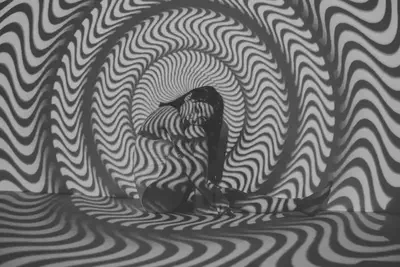
The third criterion involves an odd perception of sensory experiences, including where the body is in space (proprioceptive/kinesthetic). There can be depersonalization or detachment from the body, experiencing being out of the body, dissociation, or feeling like the body is not part of the self. For example, you might feel like your right leg is longer than your left, resulting in an odd limp. You might see a shadow out of the corner of your eye (visual illusion), hear your name being murmured (auditory illusion), feel the wind when there is none (tactile illusion), or experience a phantom smell/taste for a second or two (gustation/olfactory illusion). Remember, this is not at a level of psychosis, so they are illusions, not hallucinations.
| “Odd thinking and speech (e.g., vague, circumstantial, metaphorical, overelaborate, or stereotyped)1.” (p. 745) |
|---|
Criterion four highlights unusual thought processes that can be reflected in odd speech, without the derailment or incoherence (i.e., word salad) found in psychosis. This can be really tricky, so check out the table below:
Unusual Thought and Speech
| Type | Definition | Example |
|---|---|---|
| Vague | Not clearly defined | They kind of, maybe, sometimes, did that thing I don’t like. |
| Loose | Barely connected information | I saw a butterfly, and I really like herb and garlic butter on my steak, and cows are cute. |
| Circumstantial | Goes off track but circles back to the main point | I went to the grocery store for carrots, and carrots are orange, and I saw an orange butterfly at the park last year when I went after eating carrot soup, and I’m making carrot soup from the carrots I got at the grocery store. |
| Tangential | Goes off track and does not go back to the main point | I went to the grocery store for carrots and carrots are orange, and I saw an orange butterfly at the park last year, and the park had baseball, which I watched last night before I watched the stars in the sky. |
| Metaphorical | Compares concepts that are not related | Orange butterflies are like the sun in our darkest hour, coming up over the horizon and giving the soul a reason to be reborn. |
| Overelaborate | Too detailed | What do I like on my pizza? Well, I like supreme, and stuffed crust, and how Papa Johns makes it, and I learned how to make it too - including putting in mozzarella cheese for stuffed crust, the spices involved, where the Salami is imported from… |
| Stereotyped | Rhythmic or patterned | I run. I run. I run. I run. Fast. Fast. Fast. Fast. |
| Overly Concrete | Logical, rigid, extremely clear | I saw 101 purple small fuzzy smelly lavender petals on a flower that had a stem. |
| Overly Abstract | Provides intangible information | That’s a cool peace flower. |
| Unusual | Can be regressed or child-like | The cat runned with the mouses. |

| “Suspiciousness or paranoid ideation1.” (p. 745) |
|---|
The fifth criterion touches on brief, nondelusional beliefs that others are out to get you. For example, “The traffic cameras are always watching me,” or “My peers at work are conspiring against me.” The important thing here is that these beliefs are able to be challenged and can change, lacking the rigidity of psychosis.
| “Inappropriate or constricted affect1.” (p. 745) |
|---|
Criterion 6 involves emotional expression that does not match the context of the social cues, showcasing a misunderstanding of others’ emotions. This may look like muted, restricted emotion…like it’s there, but subtle. Or it could be inappropriate, like laughing at a sad story, hostility when providing help, or calmness during a robbery. The emotional expression is just off.
| “Behavior or appearance that is odd, eccentric, or peculiar1.” (p. 746) |
|---|
The seventh criterion seems to be an outward culmination of all the above inward, cognitive, and emotional criteria. That internal oddness can present externally, especially as there is inattention to things others care about. So, there might be outfits that don’t quite go together, that are stained, too small, or way out of fashion. Their presentation and appearance might seem unkempt and unusual. Additionally, there may be difficulty with banter, sarcasm, or joking.
| “Lack of close friends or confidants other than first-degree relatives1.” (p. 746) |
|---|
Criterion eight addresses the social aspects of schizotypal’s oddness and suspiciousness of others that results in discomfort relating to others and having problematic interpersonal functioning. There is a conflict between having a decreased desire for intimate social contact and experiencing loneliness. Also, schizoid personality disorder shares this exact same criterion, but the internal processes are different. Schizotypals are very uncomfortable and skittish with people, while schizoids are detached/uninterested in people.

| “Excessive social anxiety that does not diminish with familiarity and tends to be associated with paranoid fears rather than negative judgments about self1.” (p. 746) |
|---|
The last criterion involves persistent, intense anxiety in social situations that stems from fear, mistrust, and suspiciousness of others’ motivations that does not go away even with repeated exposure. It’s often wrapped up in paranoid fears involving others being out to get them or being hostile, especially because they know they are different and are self-conscious about it. In contrast, “regular” social anxiety tends to stem from fear of criticism that subsides in the presence of individuals deemed safe, like close friends or family. Also, just like schizoid personality disorder, schizotypal personality disorder does NOT involve psychosis and isn’t autism spectrum disorder (Criterion B).
If you want to better understand and care for a schizotypal in your life, or if you are a schizotypal personality and want to explore it, feel free to reach out! You can look on Psychology Today, or if you’re in Virginia, check out our private practice, Quest Psychological and Counseling Services for available services.
References

Doc Fish
Licensed Clinical Psychologist
I am a licensed clinical psychologist who specializes in personality, attachment, and psychodynamic treatment.